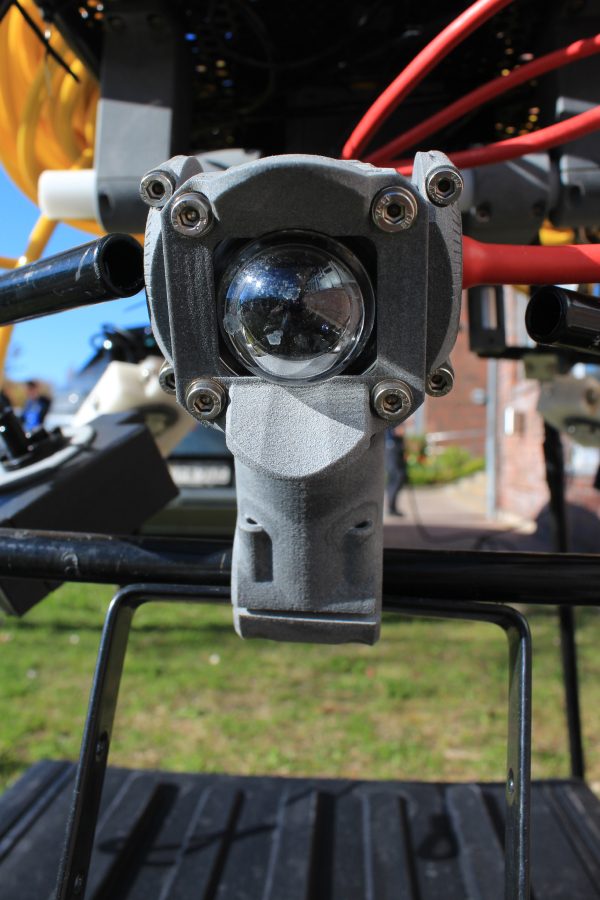
Some challenges require more out-of-the-box solutions than usual. In these cases, we develop bespoke solutions – based on our modular components, ranging from targeted system upgrades to entirely new system designs.
Some challenges come in different shapes.
If you can imagine it, we can make it happen.
Compact and scalable lander for long-term measurements on the seabed
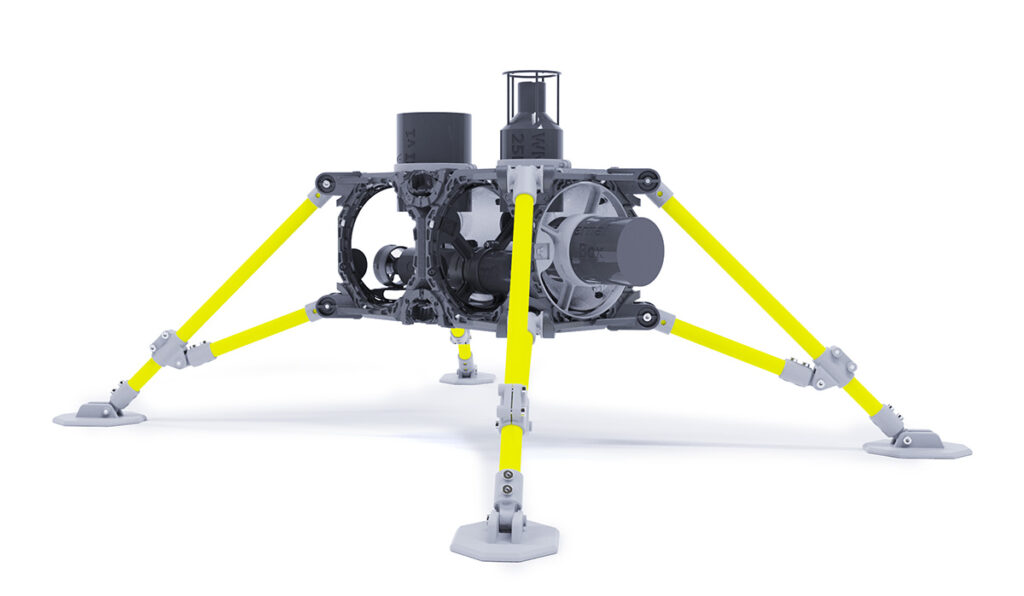
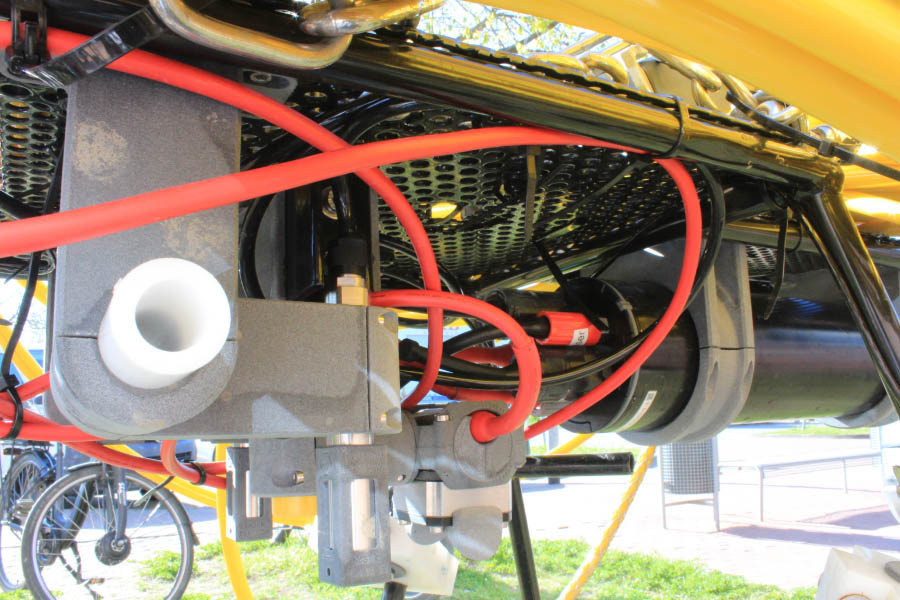
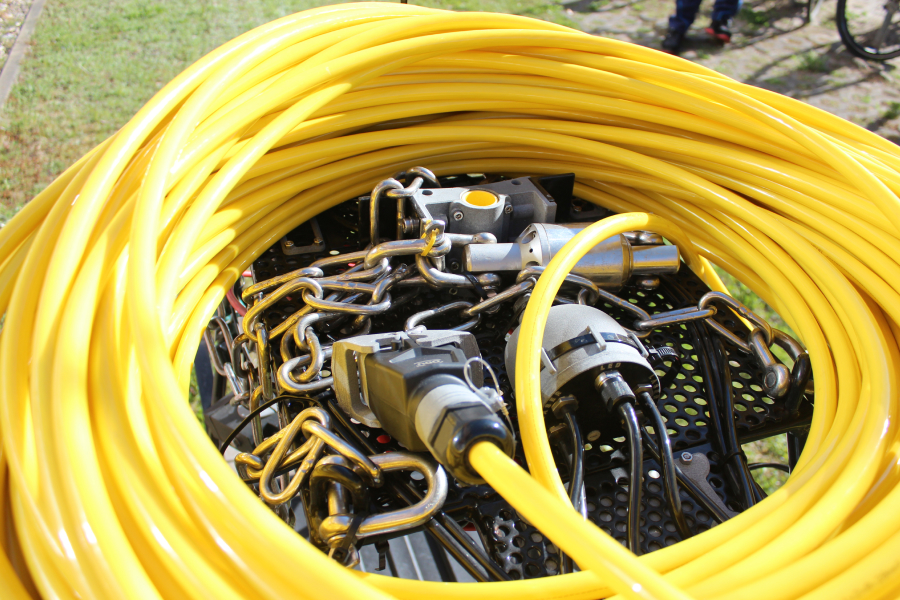
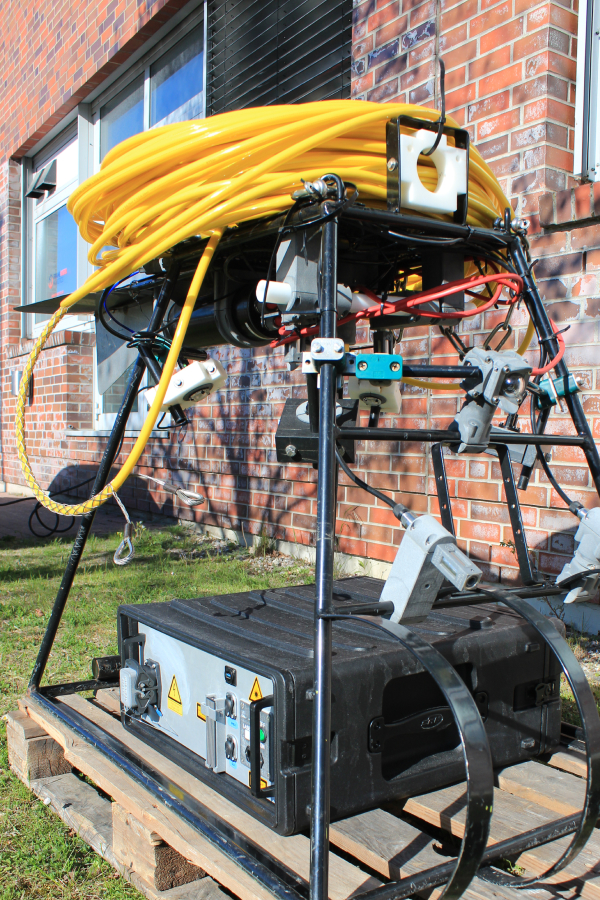
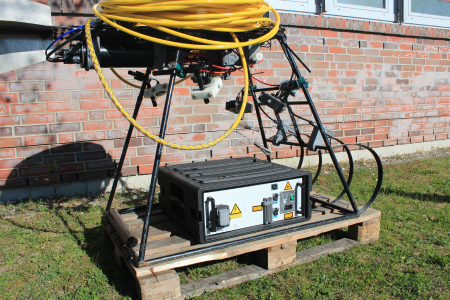
As part of a research project on the Mediterranean coast, the lander was used to ensure reliable environmental monitoring on the seabed. The lander had to be light and compact enough to fit into the boot of a car. It also needed to be possible to install various sensors and acoustic modems securely.
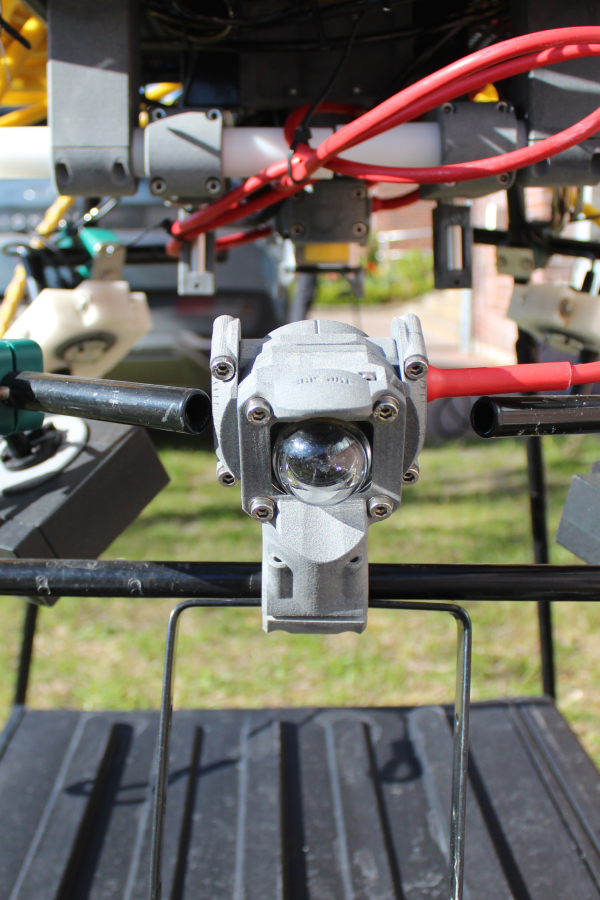
Based on our C260 standard container, we have developed a lander for a wide range of applications. It is mainly constructed from 3D-printed parts. This allows for customisation to suit new missions and ensures rapid repairs. The lander’s legs are infinitely adjustable and can therefore be adapted to a wide variety of seabed conditions.
Challenge
Environmental monitoring and data collection in offshore areas needed to be carried out with minimal infrastructure and small vessels. Transport, safe deployment and recovery had to be achieved using as few resources as possible.
Solution
A compact lander, made from robust 3D-printed parts, which offers plenty of space for sensors and modems whilst remaining portable and easy to use.
Outcome
It’s all about the data! Valuable data was collected and analysed during the lander’s mission on the Mediterranean coast.
Users
Research institutions and industry partners in a joint research project
Technical Details
- Components:
- C260 container: 2x
- Adjustable legs: 4x
- Weight modules: 4x, 3 kg each
- Subnero acoustic modem with junction box
- CONTROS HydroC CO2 sensor
- LUMA OMNI
- Optional battery: capacity 4 kWh
- Weight: 15 kg, excluding weight modules
- Dimensions:
- Body: 32.0 x 32.0 x 62.5 cm
- Lander height, variable: 32.0 – 70.0 cm
- Distance between body and seabed, variable: 0.0 – 38.0 cm
- Diagonal distance between leg contact points, variable: 153,0 – 224,0 cm
- Payload capacity: 2 x 15 litres
- Depth rating: full ocean depth
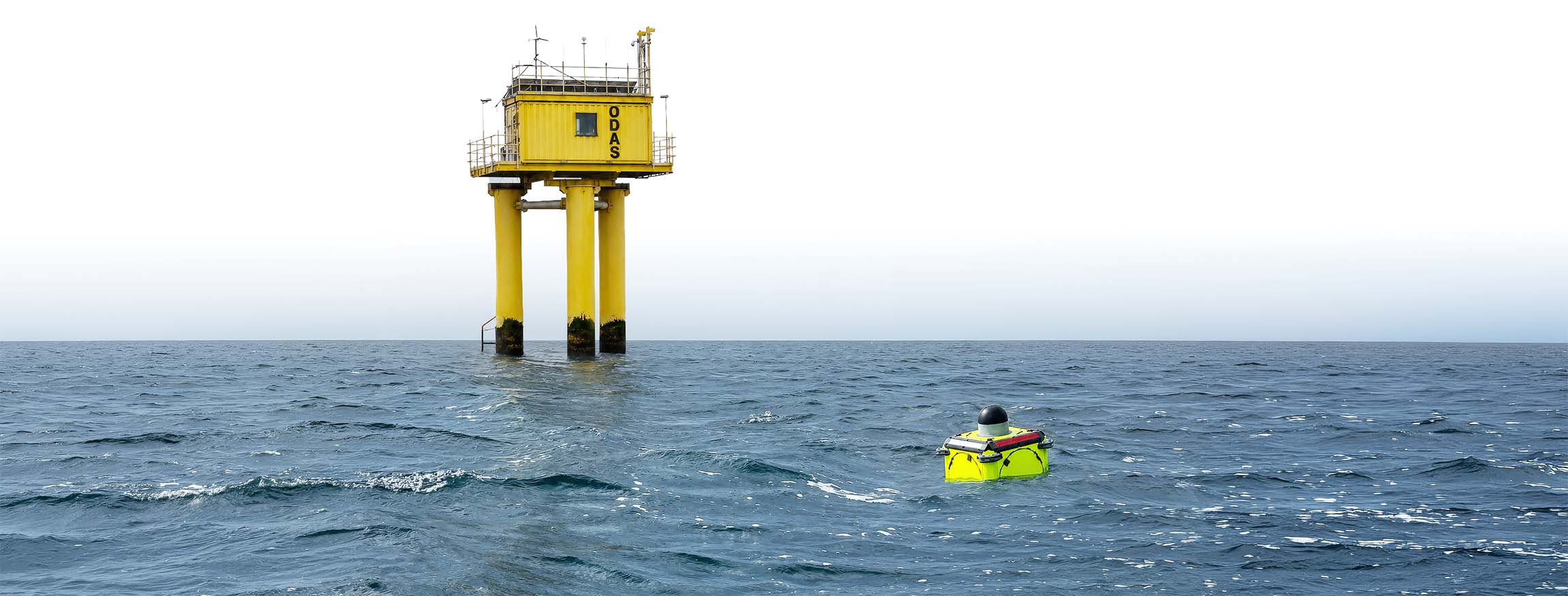
At the Digital Ocean Lab (DOL), operated by Fraunhofer IGD, underwater systems are tested in real offshore conditions. In this context, a reliable and stable interface was required between the underwater communication and positioning network and the surface side.
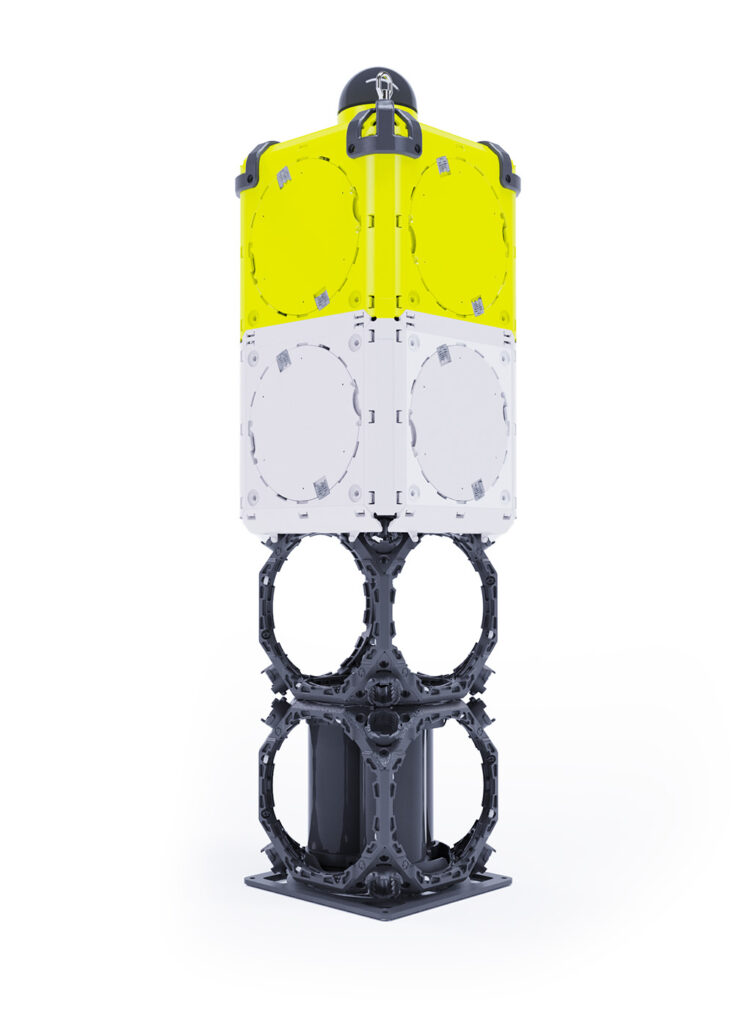
Based on our C260 standard container, we have developed a compact, rapidly deployable buoy that combines GPS positioning with a stable internet uplink. Thanks to its modular architecture, additional payload and sensors can be easily integrated, enabling the buoy to scale and adapt to evolving requirements over time.
Challenge
The offshore operation of underwater vehicles requires a reliable and stable interface between the underwater communication and positioning network and the surface.
Solution
A compact, modular buoy was developed based on our C260 standard container, equipped with GPS and a communication uplink.
Outcome
Continuous data access and coordinated underwater operations in offshore conditions.
Users
Fraunhofer IGD, University of Rostock
Technical Details
- Components: C260 container, GPS antennas, internet uplink (LTE / satellite)
- Weight: 20kg – 40kg
- Dimensions: 1,8m x 0,4m x 0,4m
- Battery capacity: 1,8kWh
- Payload capacity: 20kg
- Max. sea state: 4
Compact, lightweight, and modular buoy for reliable surface communication and positioning
High-performance data and power transmission for environmental monitoring on tethered sensor carriers
A telemetry system has been developed for a ship’s winch with a tethered CTD sensor carrier to transmit high-resolution video images and supply power to sensors, LED spotlights and lasers.
To modernise an analogue video system on a CTD sensor carrier aboard a research vessel, a telemetry system featuring a digital camera and interfaces for additional sensors was developed. It enables the transmission of Full HD video data from a water depth of 1,000 metres and, furthermore, the reading of data from multiple serial interfaces over a cable length of 1,200 m (copper).
Challenge
Conventional robust copper cables on ship’s winches experience high attenuation and electrical resistance over long lengths; furthermore, these cables are exposed to numerous disruptive factors on board the ship. A technical solution had to be developed that, despite these circumstances, would provide a secure connection, high data rates and sufficient electrical power for the planned sensors.
Solution
Based on the telemetry used for our remote-controlled systems, a robust telemetry system was developed that could be integrated into the research vessel’s winch.
Result
Scientists on the research vessel can now deploy and read out in real time more sensors simultaneously within the water column whilst the CTD sensor carrier is in use. This enables new correlations in the water column to be better investigated and researched.
User
Research institution on the Baltic Sea
Technical Details
- Components:
- Topside Unit: power supply, data connection, control
- Main Unit: data connection, sensor interfaces, camera interface, power supply for external sensors, LEDs, laser
- Weight:
- Main Unit: 8 kg
- Topside Unit: 15 kg
- Dimensions:
- Main Unit: OD 75 mm x 400 mm
- Topside Unit: 19” rack 2H
- Depth rating: 1000 m
- Power supply: 600 W at 12 / 24 / 48 VDC
- Data rate: up to 1 Gbit/s via coax cable, depending on cable type and length
- Options: Power Over Coax up to 1.5 kW; Fiber Optic up to 10 Gbit/s
To modernise an outdated video system for seabed monitoring, a digital camera system has been developed for use at depths of up to 500 metres. It is equipped with multiple sensor interfaces, several high-resolution cameras, LED spotlights and lasers. The system offers the ability to synchronise, record and view live video data from the seabed alongside sensor data, the vessel’s position, transects and other data.
Challenge
The recording of environmental data on the seabed should be optimised and simplified in order to provide significant added value for science. A compact and portable video recording system had to be developed for mobile use on ships, one that is easy to operate. It features digital transmission from multiple high-definition cameras via a standard copper cable and also allows external data to be integrated into the system. Furthermore, an intuitive user interface was required, enabling the user to overlay various types of information onto the video image.
Solution
Drawing on the telemetry capabilities of our remote-controlled systems, combined with the cameras, LED spotlights, lasers and comprehensive software package developed by FWR, a state-of-the-art video system has been developed for advanced seabed monitoring.
Result
New functions and high image quality, combined with the easy integration of relevant information, facilitate scientific work and significantly increase the value of the collected data.
User
Research institution on the Baltic Sea
Technical Details
- Components:
- Topside Unit: power supply, data connection, control, recording
- Main Unit: data connection, sensor interfaces, camera interface, power supply for external sensors, LEDs, laser
- 4K Camera: bottom view
- Full HD Camera: front view
- 4x Laser
- 4x LED spotlights
- Weight:
- Main Unit: 8 kg
- Topside Unit: 15 kg
- Dimensions:
- Main Unit: OD 75 mm x 400 mm
- Topside Unit: 19” rack 4H
- Depth rating: 500 m
- Power supply: 600 W at 12 / 24 / 48 VDC
- Data rate: up to 1 Gbit/s via coax cable, depending on cable type and length
- Options: Power Over Coax up to 1.5 kW; Fiber Optic up to 10 Gbit/s
Portable digital video system for seabed monitoring in a scientific context